
Exporting sustainable packaging is not easy. You face complex regulations, different standards for every country, and the fear of customs rejection. One mistake in paperwork or material composition can cost you thousands of dollars and damage your reputation. This guide clarifies the confusion.
To navigate export requirements for eco-friendly food contact materials, you must secure region-specific certifications like FDA and LFGB for safety, and ASTM D6400 or EN13432 for compostability. You also need to verify PFA-free status, ensure accurate labeling to avoid greenwashing claims, and provide a full Declaration of Compliance (DoC) for customs clearance.
I have seen many good products get stuck at the border. It is frustrating. You have the right intentions, but the bureaucracy stops you. I want to help you avoid those traps. In the following sections, I will break down the specific certifications, chemical bans, and labeling rules you need to know.
What are the essential certifications for exporting biodegradable tableware to the US and Europe?
The United States and Europe have different rules. If you mix them up, you cannot sell your product. You need to know exactly which certificate applies to your target market.
For the US market, you must meet FDA food safety standards and ASTM D6400 for compostability (often certified by BPI). For Europe, you need LFGB or EFSA for food safety and EN13432 for compostability (certified by TUV Austria or Din Certco).
I often talk to buyers who think one certificate works everywhere. It does not. The testing methods are different. In my experience at Ecosourcecn, helping a client understand this difference is the first step to success. Let’s look deeper into how these standards function.
The United States focuses heavily on the FDA (Food and Drug Administration). This is for safety. It ensures that no dangerous chemicals migrate from the container into the food. But for the "eco-friendly" part, the government relies on private standards. The biggest one is ASTM D6400. This is a lab test. It proves the plastic or paper breaks down in industrial facility conditions. BPI (Biodegradable Products Institute) uses this standard. If you want to sell in California or New York, a BPI logo is very powerful.
Europe is stricter. They have the "Single Use Plastic Directive." For food safety, Germany uses LFGB, which is known as the hardest test in the world. If your bamboo or bagasse passes LFGB, it is safe anywhere. For compostability, the law requires EN13432. Organizations like TUV Austria give out the "OK Compost" labels based on this.
Here is a breakdown of the differences:
| Feature | United States Market | European Market |
|---|---|---|
| Food Safety Authority | FDA (21 CFR) | EFSA / National Agencies (e.g., BfR for Germany) |
| Safety Test Name | FDA Extraction Test | LFGB (Sensory & Migration Test) |
| Compostability Standard | ASTM D6400 / ASTM D6868 | EN 13432 |
| Primary Certifying Body | BPI (Biodegradable Products Institute) | TUV Austria / Din Certco |
| Heavy Metal Limits | Less Strict | Very Strict |
| Disintegration Time | Usually 180 Days | Usually 90-180 Days (depends on program) |
You must plan this early. Testing takes time. A BPI certification can take 3 to 6 months. TUV can take longer. I always tell my clients to start the application before the product design is final. If you fail a test because the material is too thick, you have to start over. This costs money. We help our partners pre-screen materials to avoid this delay.
Why are PFAs and chemical safety testing becoming critical for food contact compliance?
Chemical safety is the new battleground. It is not just about bacteria anymore. Governments are banning invisible chemicals that stay in the environment forever.
PFAs (Per- and polyfluoroalkyl substances) are increasingly banned in food packaging across North America and Europe because they do not break down. To export successfully, you must provide test reports proving your molded fiber or paper products are PFA-free.
I remember when bagasse (sugarcane fiber) was the perfect solution. But, to stop oil from leaking, factories used PFAs. Now, we know these are dangerous. "Forever chemicals" link to health problems. As a result, regulations have shifted rapidly.
Many states in the US, like California, New York, and Washington, have banned added PFAs in food packaging. Europe is moving in the same direction with REACH regulations. This creates a massive challenge for exporters. You cannot just claim a product is "natural." You need proof. A simple "biodegradable" claim is false if the product leaves toxic fluorine in the soil.
When we source products at Ecosourcecn, we look for "oil-proof" alternatives. New technologies use acrylic-based or starch-based additives. These are safer. However, they are often more expensive or less effective with very hot oil. This is a trade-off you must manage.
You must perform specific lab tests. The standard test looks for "Total Fluorine." If the fluorine level is below a certain limit (usually 100ppm or less), it is considered PFA-free.
Here is why you need to focus on chemical composition:
| Component | Why it is used | Why it is a problem | The Safe Alternative |
|---|---|---|---|
| PFAs | Oil and water resistance | Carcinogenic; persists in soil | Acrylic/Water-based coatings |
| Bleaching Agents | To make paper white | Chlorine creates dioxins (toxic) | TCF (Totally Chlorine Free) or Unbleached |
| Heavy Metals | Inks and dyes for logos | Toxic accumulation in compost | Soy-based or Water-based inks |
| BPA | Plastic hardener (in linings) | Hormone disruptor | PLA linings or Bio-PBS |
I advise you to ask your supplier for a recent Fluorine test report. Do not accept a report older than one year. Factories change formulas. You need to be sure the current batch is safe. If customs test your product and find PFAs, they will destroy the shipment. You lose everything.
What specific labeling requirements must be met for compostable packaging markets?
A good product with a bad label is unsellable. Laws regarding "green" claims are tightening. You cannot mislead the consumer.
You must strictly follow labeling laws, such as the FTC Green Guides in the US, which prohibit vague terms like "eco-friendly." Labels must specify if the item is industrially compostable or home compostable and often require third-party certification logos to be visible.
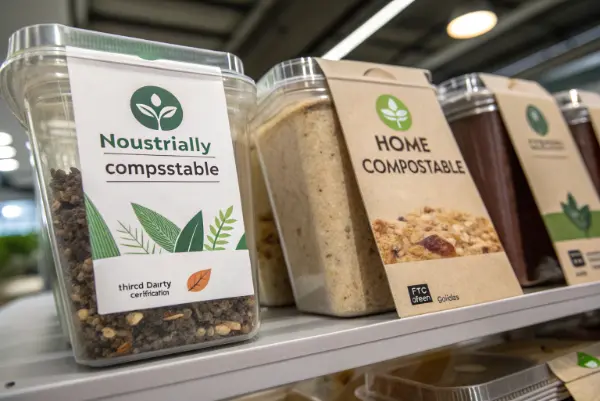
I see this mistake often. A brand writes "100% Biodegradable" on a cup. This sounds good. But in California, this is actually illegal on plastic products. The word "biodegradable" is considered misleading because everything biodegrades eventually, even if it takes 500 years. The law wants you to use the word "Compostable" only if you have scientific proof.
In France, the "Triman" logo is mandatory. It tells people how to recycle or compost the item. If you miss this logo, you can get fined. In the UK, rules are changing about "plastic-free" marks on cups that have aqueous linings. It is very confusing.
The key is transparency. You must label the product, the box, and the carton. Traceability is also part of labeling. I suggest using QR codes. A QR code can take the customer to a webpage. There, you can show your certificates. You can show the factory. This builds trust.
Here are the critical elements your design team needs to include:
| Element | Description | Mandatory Region Example |
|---|---|---|
| Certification Logo | BPI Apple, TUV Seedling | US, EU (for verification) |
| Material ID | #7 PLA or specific compost code | US, Global |
| Disposal Instructions | "Commercially Compostable Only" | California, Washington |
| Batch Number | For recall and tracing | EU (General Food Law) |
| Manufacturer Info | Name and address on packaging | EU, Canada |
At Ecosourcecn, we check our clients’ artwork files before printing. We have seen cases where a client uses a generic "recycle" loop on a compostable bag. This confuses the recycling plant. Compostable bags clog recycling machines. Your label must clearly say "Do Not Recycle" if it goes to compost. Correct labeling protects the waste stream. It ensures your product actually turns into soil, not landfill trash.
How does supply chain traceability impact the export of eco-friendly products?
Paperwork is boring, but it is the backbone of export. Without a clear paper trail, your "green" story is just a story. Customs officers want facts.
Supply chain traceability requires a Declaration of Compliance (DoC) and a clear audit trail from raw material to finished goods. This documentation proves the origin of materials, ensures no forced labor was used, and validates safety claims for customs authorities.
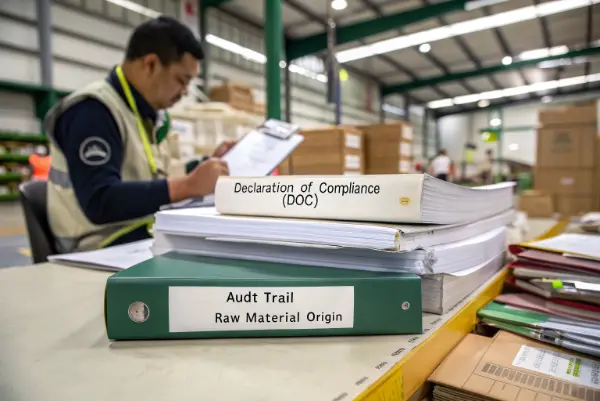
Traceability is becoming a legal requirement. In the US, the UFLPA (Uyghur Forced Labor Prevention Act) means you must prove where your cotton or bamboo comes from. If you cannot prove the farm location, customs can hold your goods. In Europe, the new deforestation laws mean you must prove your paper does not come from clear-cut forests. FSC (Forest Stewardship Council) certification is the best way to prove this.
I handle these documents daily. The most important document for Europe is the DoC (Declaration of Compliance). It is not just an invoice. It is a legal promise. It lists every substance in your product. It lists the testing conditions. It lists the regulations you meet. If a health inspector walks into your customer’s restaurant in Berlin, they will ask for this DoC. If your customer does not have it, they get fined. Then, they blame you.
You also need to manage the physical conditions of shipping. Eco-materials are sensitive. PLA (corn starch plastic) melts at roughly 45 degrees Celsius. If you ship a container of PLA cups through the equator in summer, it gets hot inside the metal box. The cups can warp. They arrive oval, not round. You need thermal liners or refrigerated containers.
Here is a checklist of the documentation and logistics factors you must control:
| Item | Purpose | Importance Level |
|---|---|---|
| Declaration of Compliance (DoC) | Legal proof of safety (EU) | Critical |
| FSC Certificate | Proof of responsible forestry | High (for paper/wood) |
| Transaction Certificate (TC) | Proof for a specific shipment | High (for organic/recycled) |
| Temperature Log | Records heat during shipping | Medium (for PLA items) |
| HS Code Classification | Determines duty rates | Critical |
I once helped a client who used the wrong HS code. They classified a sugarcane plate as "plastic" because it had a coating. They paid 6.5% duty. We changed it to the correct "vegetable fiber" code, and the duty dropped to 0%. Understanding the material composition helps you save money on taxes. This is why we insist on knowing every detail of the supply chain.
Conclusion
Exporting eco-friendly food packaging requires more than just a good product. You must master safety certifications, pass strict chemical tests, design compliant labels, and maintain perfect documentation. It is complex, but it protects your business. At Ecosourcecn, we handle these details so you can focus on sales. Let’s make your supply chain green and compliant.

