
You want to launch your new summer smoothie cups, but the shipment is stuck at the port. Your customers are waiting, and your storage room is empty. This is a nightmare for any business owner. If you do not manage your time well, you lose money and trust.
To manage seasonal beverage packaging effectively, you must forecast demand 3 to 6 months in advance. Establish a "buffer stock" strategy to handle unexpected spikes in sales. Communicate clearly with your suppliers about their production capacity during holidays. By aligning your ordering schedule with shipping lead times, you ensure you never run out of biodegradable cups or straws when you need them most.
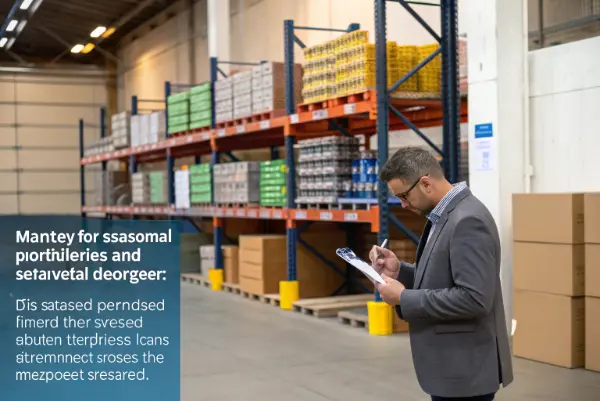
I have seen many clients struggle with this exact problem. They have great products, but they arrive too late. Let’s look at how to fix this and keep your business running smoothly.
Why does seasonal demand affect your packaging supply chain?
Demand spikes for iced coffee cups in July or hot cocoa cups in December can be crazy. If you do not plan for this, you fail. Your competition will take your sales because they have stock and you do not. You need to understand why this happens.
Seasonal demand creates pressure on raw material availability and factory production lines. During peak times like Christmas or summer, factories are often overbooked. This causes longer lead times and potential shipping delays at ports. Understanding these cycles helps you book production slots early, ensuring your custom-printed packaging arrives before the season starts.
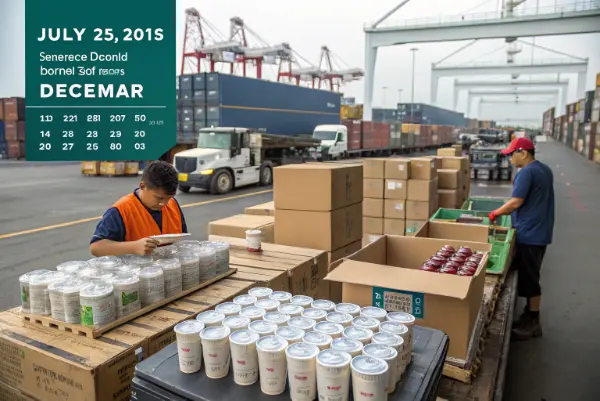
Let’s look closer at why the supply chain breaks down during busy seasons. It is not just about the factory making your cups. It is a chain reaction.
The Ripple Effect of High Demand
When everyone orders at the same time, the system gets clogged. I often explain this to my clients using the "Bullwhip Effect." A small increase in consumer demand leads to a big panic in ordering from the factory.
- Raw Materials: For us at Ecosourcecn, we use PLA and bagasse. When summer approaches, demand for cold cups rises globally. If the raw material suppliers run out of PLA resin, the factory cannot start your order.
- Factory Capacity: Machines can only run 24 hours a day. They cannot run 25 hours. If a factory is fully booked for October delivery, and you place an order in September, you will wait.
- Logistics Congestion: This is a big one. During peak export seasons, ports in Asia and North America get full. Containers sit on the dock waiting for a ship. Trucks are hard to book.
Seasonal Events That Impact Lead Times
You need to watch the calendar. It is not just your local holidays that matter. You must look at where the goods are made.
| Event | Time of Year | Impact on Supply Chain |
|---|---|---|
| Chinese New Year | Jan/Feb (Varies) | Factories close for 2-4 weeks. Production stops completely. |
| Summer Peak | May – August | High demand for cold beverage packaging. PLA shortages possible. |
| Golden Week | October | 1-week shutdown in China. Shipping delays before and after. |
| Christmas Rush | Oct – Dec | Ports are congested with retail goods. Shipping prices go up. |
Critical Thinking: The Cost of Being Late
If you miss the start of the season, you have two bad choices. One, you pay for air freight, which destroys your profit margin. Two, you wait for sea freight, and the season is half over when goods arrive. Then you are stuck with inventory you cannot sell until next year. For biodegradable products, this is risky because they have a shelf life. Proper planning avoids this waste.
When is the best time to place orders for seasonal peaks?
Ordering too late means expensive air freight or empty shelves. Ordering too early ties up your cash flow in inventory you do not need yet. It is a hard balance to find. You need a specific timeline to follow.
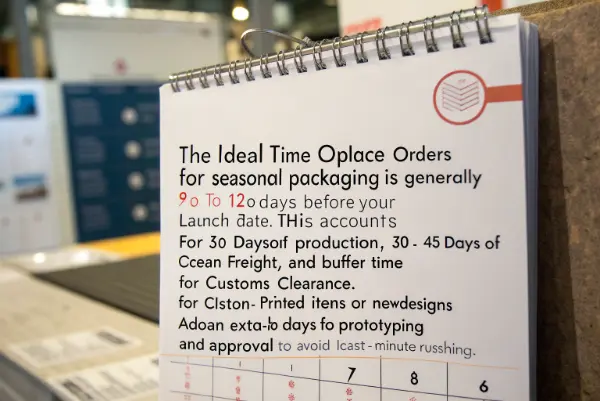
The ideal time to place orders for seasonal packaging is generally 90 to 120 days before your launch date. This accounts for 30 days of production, 30-45 days of ocean freight, and buffer time for customs clearance. For custom-printed items or new designs, add an extra 30 days for prototyping and approval to avoid last-minute rushing.
Many buyers look at the launch date and work backward, but they forget the small steps. You cannot just count shipping time. You must count everything.
The Reverse Timeline Strategy
I always tell Jacky and other buyers to use a "Reverse Timeline." Start with the day you need the product in your warehouse. Then subtract every step.
Let’s say you need custom printed PLA cups for a Summer Campaign starting June 1st.
- Warehouse Receipt: June 1st.
- Inland Transport (Trucking): 1 week. (May 24th)
- Customs Clearance: 1 week. (May 17th)
- Ocean Freight: 5-6 weeks (from Asia to North America). (April 5th)
- Production Time: 4 weeks. (March 8th)
- Sample Approval: 2 weeks. (February 22nd)
- Design Finalization: 2 weeks. (February 8th)
So, to launch in June, you must start talking to us in February.
Why "Just-in-Time" is Dangerous for Imports
The "Just-in-Time" model works well if your supplier is down the street. It does not work well for international shipping.
- Weather Delays: Typhoons in Asia or snowstorms in Canada can stop ships and trucks.
- Customs Inspections: Sometimes, customs officers pick your container for a random check. This can add 7 to 14 days. You cannot control this.
- Design Changes: If you see the first sample and want to change the color, you add weeks to the timeline.
Timeline Breakdown for Different Products
Not all products take the same time to make.
| Product Type | Production Time | Notes |
|---|---|---|
| Stock Items (Standard) | 1-2 Weeks | Usually ready to ship, just need packing. |
| Custom Print (Simple) | 3-4 Weeks | Need time to make printing plates. |
| New Mold (Custom Shape) | 6-8 Weeks | Requires mold creation and testing before mass production. |
If you are doing a private label with a new shape, you need to start 5 to 6 months early. If you are just buying standard white bagasse bowls, 3 months is usually enough.
How does safety stock protect your business?
You predicted selling 10,000 cups, but you sold 15,000. Now you are out of stock. Customers are unhappy and go to another shop. You need a safety net to catch you when you fall.
Safety stock acts as an insurance policy against supply chain disruptions or unexpected sales spikes. By keeping an extra 15% to 20% of your average inventory on hand, you can continue operations even if a shipment is delayed by a week. This is crucial for biodegradable products that have specific shelf lives but high demand volatility.
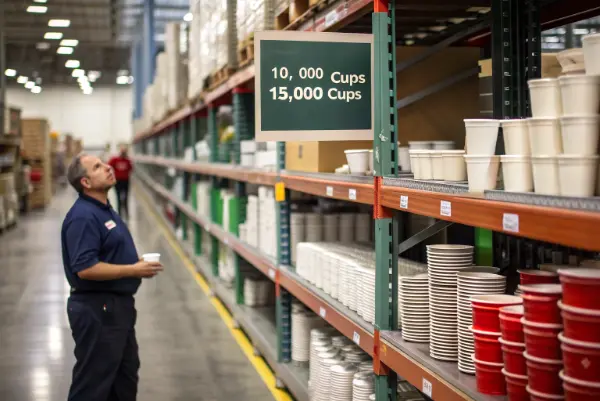
Safety stock is not just "extra stuff." It is a calculated amount to keep you safe. I help my clients calculate this so they do not waste money on storage but also do not run out.
Calculating the Right Amount
You do not want too much stock because warehouse space costs money. Also, eco-friendly products like PLA have a shelf life (usually 12 months). You cannot store them forever like plastic.
Here is a simple way to think about it:
- Average Daily Sales: How many cups do you use a day?
- Max Lead Time: What is the longest it has ever taken for an order to arrive?
- Average Lead Time: What is the normal time?
Formula:
(Max Daily Sales x Max Lead Time) – (Average Daily Sales x Average Lead Time) = Safety Stock.
If this math is too complex, a good rule of thumb is to keep 2 weeks of stock on hand at all times during the busy season.
The Cost of Stockouts vs. Holding Costs
You have to weigh two costs against each other.
- Holding Cost: The rent for the warehouse, the insurance, and the risk of the product getting old.
- Stockout Cost: The profit you lose when you have no cups. Plus, the lost customer loyalty.
For most businesses, the stockout cost is much higher. If a coffee shop runs out of cups, they cannot sell coffee. They lose the whole sale, not just the cup cost. Therefore, carrying a little extra inventory is worth the cost.
Storage Conditions Matter
When you hold safety stock of eco-products, you must be careful.
- PLA Products: Keep them under 40°C (105°F). If your warehouse gets hot in the summer, the cups might warp.
- Paper/Bagasse: Keep them dry. Humidity can make them soft.
- First-In-First-Out (FIFO): Always use the old stock first. This is very important for biodegradable items. You do not want a box sitting in the back corner for two years.
How can your supplier help reduce lead times?
Some suppliers are slow and do not communicate. This leaves you in the dark, wondering where your goods are. You need a partner, not just a seller, to win in this market.
A good supplier reduces lead times by offering "make-and-hold" inventory options or prioritizing your production slots. They should provide transparent tracking and anticipate raw material shortages. Working with a supplier who understands global logistics and customs processes can shave weeks off your total delivery time compared to inexperienced manufacturers.
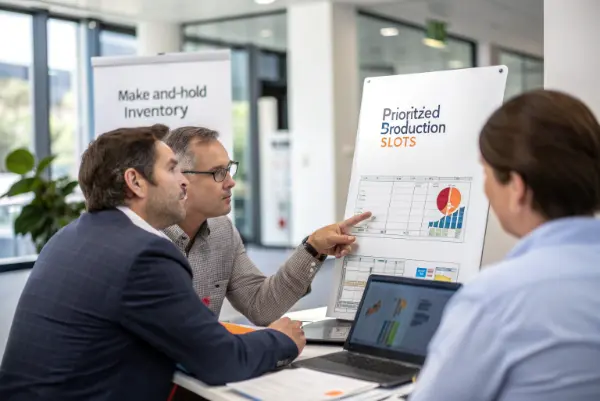
At Ecosourcecn, we do more than just sell products. We act as an extension of your team. We know that lead time is not just about shipping; it is about communication and planning.
The Power of Forecasting Sharing
The best way to reduce lead time is to tell your supplier your plans early. If you tell me, "I plan to sell 100,000 cups in Q4," I can prepare.
- Raw Material Prep: I can buy the PLA or pulp ahead of time.
- Production Slots: I can reserve machine time for you before other customers book it.
- Stable Pricing: If we book early, we can lock in prices before raw material costs go up.
Supplier Capabilities Checklist
When you choose a supplier, do not just look at the price. Look at their ability to manage the supply chain.
| Capability | Why it Helps You |
|---|---|
| In-House Logistics | We handle the booking of ships and trucks, so you do not have to find a broker. |
| Certification Knowledge | We know ASTM D6400 and EN13432. We have the paperwork ready so customs does not hold the cargo. |
| Scalability | Can the factory double production if you grow fast? We can. |
| Transparency | We send photos of production and loading. You know exactly when your goods leave. |
Private Label and Customization
Jacky often needs custom packaging for his brand. Customization usually adds time. However, a smart supplier can speed this up.
- Artwork Templates: We provide clear templates so your designer gets it right the first time.
- Digital Proofing: We use 3D digital proofs to speed up approval, so we do not always have to mail a physical sample back and forth.
- Pre-Printing: For some clients, we print the boxes ahead of time and store them. When they order, we just make the product and pack it. This saves 2 weeks.
Building a long-term relationship allows us to learn your patterns. We can predict what you need before you even ask. This is the secret to short lead times.
Conclusion
Managing inventory for seasonal beverage packaging requires a mix of math and communication. You need to plan 90 days out, keep a safety stock buffer, and work closely with a supplier like Ecosourcecn. If you do these things, you will avoid stress and keep your customers happy.
