
Switching to eco-friendly beverage packaging is a great move for your brand, but it comes with a major risk. If your new cups or containers aren’t compliant, you could face recalls, legal issues, and a damaged reputation. Navigating the world of food safety regulations for sustainable materials can feel overwhelming, leaving you unsure if you’re truly protected.
To ensure your eco-friendly beverage packaging is food-safe, you must verify that the materials and the final products hold key certifications like FDA, LFGB, or equivalent regional standards. This involves requesting compliance documents from your supplier, understanding material-specific risks (like chemical migration), and confirming that the manufacturing process follows Good Manufacturing Practices (GMP). Never assume "eco-friendly" automatically means "food-safe"—always demand proof of testing and certification for direct food contact.
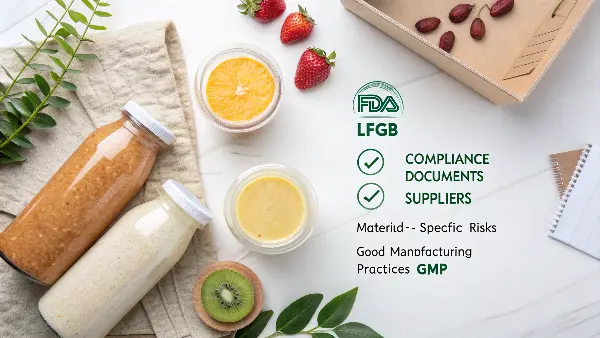
It’s a common trap to focus so much on sustainability that food safety becomes an afterthought. But for a business like yours, and for mine, it has to be the number one priority. Getting it wrong isn’t an option. We’ve helped hundreds of partners navigate this exact challenge, turning confusion into a clear, actionable compliance strategy. The key is to know what to look for and what questions to ask.
Let’s break down exactly what you need to do to protect your customers and your brand.
What Key Certifications Should You Look For in Food-Safe Packaging?
You’ve found a promising new line of compostable cups, but the supplier’s website is vague about certifications. You know compliance is non-negotiable, but the alphabet soup of standards like FDA, LFGB, and BPI feels confusing. Choosing the wrong product could mean failing an audit or, worse, putting customers at risk. How do you know which logos actually matter?
For food-safe packaging, the most critical certifications validate that materials are safe for direct food contact. In the U.S., look for FDA (Food and Drug Administration) approval. In Europe, the LFGB (German Food and Feed Code) is a highly respected standard. For compostability, BPI (Biodegradable Products Institute) in North America and TÜV Austria (OK compost) or DIN CERTCO in Europe are essential. Always ask your supplier for current certificates for these specific standards.
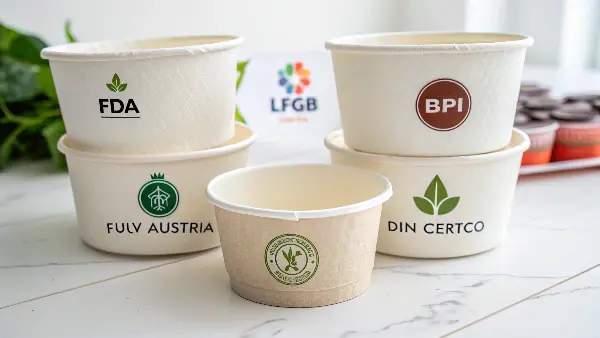
I remember working with a client in Canada, much like Jacky, who was sourcing PLA-lined paper cups for a new coffee chain. They were focused entirely on the FSC certification for the paper and the BPI certification for compostability. They almost overlooked demanding specific food-contact documentation for the PLA lining itself. We had to explain that while compostability is great, the primary test is whether the material is safe for hot, acidic liquids like coffee. We guided them to request the supplier’s FDA and LFGB test reports, which confirmed the lining was inert and safe. It was a close call that highlighted a critical lesson: you need a layered approach to certification. One standard covers the material’s end-of-life, but another covers its primary function—safely holding your product.
Breaking Down the Essential Certifications
To make this clearer, let’s separate the certifications into two main categories: those for food contact safety and those for environmental claims. Both are important, but they are not interchangeable.
- Food Contact Safety: This is the most critical aspect. These certifications ensure that no harmful chemicals will leach from the packaging into the beverage.
- Environmental & Compostability Claims: These verify the product’s eco-friendly credentials, such as its ability to biodegrade or be composted.
Here is a simple table to help you distinguish between them:
| Certification | Region | Primary Purpose | What It Guarantees |
|---|---|---|---|
| FDA | USA | Food Contact Safety | The material is considered safe for direct contact with food and beverages. |
| LFGB | Germany / EU | Food Contact Safety | A very strict standard ensuring no materials migrate to food in harmful amounts. |
| BPI | North America | Compostability | The product is certified to break down in a commercial composting facility. |
| TÜV Austria | Global / EU | Compostability | Certifies products for industrial (‘OK compost’) or home (‘OK compost HOME’) composting. |
| FSC | Global | Sourcing | Ensures paper and wood products come from responsibly managed forests. |
When you source your packaging, your first question should always be, "Can you provide the current FDA or LFGB compliance certificates?" Only after you have confirmed that should you move on to verifying the environmental claims.
Are All Biodegradable Materials a`utomatically Food-Safe?
There’s a dangerous assumption in the market that if a material is "natural" or "biodegradable," it must be safe for food. This leads many businesses to select packaging based on its green credentials alone, without a second thought for compliance. But raw materials undergo processing, and additives or contaminants could easily make the final product unsafe for consumers.
No, "biodegradable" does not automatically mean "food-safe." Materials like PLA, bagasse, or bamboo require processing, and may include binders, coatings, or additives to achieve desired functions like heat or moisture resistance. These added substances must be independently certified as food-grade. For example, a bamboo cup might use a non-food-safe resin. Always verify the food-contact certification of the final product, not just the raw material.
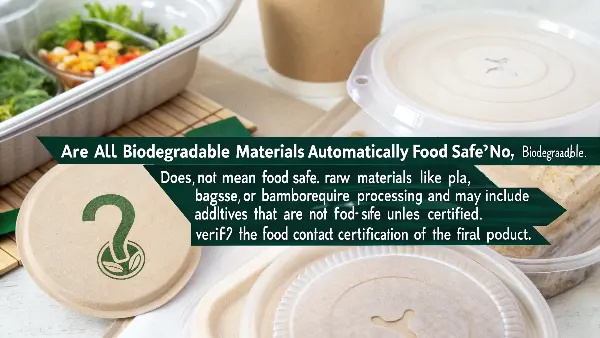
This is one of the biggest hurdles we help our partners overcome. The excitement around new, innovative materials can sometimes overshadow due diligence. For instance, wheat straw and bagasse (sugarcane fiber) are fantastic, renewable resources. But to turn that raw fiber into a cup or a lid, it has to be molded. This process involves heat, pressure, and sometimes sizing agents to make it water-resistant. We insist that our manufacturing partners use only FDA-approved processing aids. Furthermore, we test the final products to ensure that no Per- and Polyfluoroalkyl Substances (PFAS), often used for grease and water resistance, are present, as these are a major health concern. The journey from a plant in a field to a cup in a customer’s hand involves many steps, and food safety must be checked at every single one.
From Plant to Product: The Safety Journey
Understanding why a natural material isn’t inherently food-safe requires looking at the production journey. Let’s trace the path of a common material like bagasse.
- Harvesting: Raw sugarcane is crushed to extract juice. The leftover fiber is bagasse. At this stage, it could have agricultural residues or contaminants from the field.
- Pulping & Cleaning: The bagasse is turned into a pulp. This process involves washing and sometimes bleaching to ensure a clean, consistent material. The cleaning agents used must be food-grade and thoroughly rinsed out.
- Molding: The pulp is mixed with water and sometimes a strengthening or water-proofing agent. It’s then pressed into its final shape (e.g., a cup or lid) and dried at high temperatures. The agents used here are a critical control point for food safety.
- Finishing: Some products might get a coating, like a PLA lining, to handle hot liquids. This lining must also be certified for food contact.
As you can see, there are multiple points where non-food-safe substances could be introduced. That’s why simply knowing your cup is "made from sugarcane" isn’t enough. You need proof that the finished product that touches your customer’s beverage has been tested and certified safe.
How Does Material Choice Affect Beverage Safety and Quality?
You’re trying to choose between PLA-lined paper cups, CPLA lids, and bagasse cups. Each one has a different feel, cost, and environmental benefit. But you’re also wondering how they perform with different beverages. Will a PLA cup alter the taste of hot coffee? Can a bagasse cup handle an acidic fruit juice without degrading? Material choice goes beyond just compliance; it impacts customer experience.
Your choice of material directly impacts beverage safety, taste, and stability. PLA is stable for cold drinks but can deform with hot liquids unless it’s crystallized (CPLA). Paper cups require a PLA or aqueous coating to prevent leaks and transfer of paper taste. Bagasse is excellent for both hot and cold use but must be certified free of contaminants and PFAS. Each material has a specific operational temperature and chemical resistance you must match to your beverage.
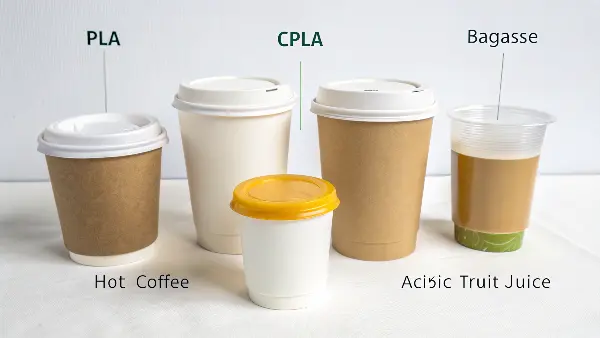
Choosing the right material is a balancing act. I’ve seen clients choose standard PLA for hot beverages to save costs, only to receive complaints about cups becoming soft. It’s a classic mistake. That’s why we always start the conversation by asking, "What are you serving, and at what temperature?" A cold-brew coffee business has very different needs than a shop selling hot tea. For hot drinks over 85°C (185°F), CPLA (Crystallized Polylactic Acid) is a must for lids and utensils because it’s engineered for higher heat tolerance. For acidic drinks like lemonade, we need to ensure any PLA lining won’t break down. It’s our job to provide not just a product, but a solution that is perfectly suited—and perfectly safe—for its intended use.
Matching Materials to Your Beverages
To ensure both safety and a great customer experience, you need to match the material to the application. Here’s a quick guide to help you make the right choice.
PLA (Polylactic Acid)
- Best For: Cold beverages like iced coffee, smoothies, sodas, and juices.
- Temperature Range: Up to 40°C (105°F).
- Key Consideration: Standard PLA will warp or melt with hot liquids. It is derived from corn starch, is transparent, and ideal for showing off colorful drinks. Ensure it’s certified for food contact to rule out any processing contaminants.
CPLA (Crystallized Polylactic Acid)
- Best For: Hot beverage lids, coffee stirrers, and cutlery.
- Temperature Range: Up to 90°C (194°F).
- Key Consideration: CPLA is made by heat-treating PLA, which makes it opaque (usually white or black) and much more heat-tolerant. It’s the go-to safe choice for anything that will touch a hot drink.
Paper (with a Lining)
- Best For: Hot and cold beverages, especially coffee and tea.
- Key Consideration: The paper itself isn’t liquid-proof. The safety comes from the lining.
- PLA Lining: A bioplastic lining that makes the cup compostable. It’s great for hot drinks and doesn’t impart a plastic taste.
- Aqueous Coating: A water-based coating that is repulpable and biodegradable. It’s a newer technology gaining traction as a plastic-free alternative.
You must verify the certification of the lining, not just the paperboard.
Bagasse (Sugarcane Fiber)
- Best For: Hot and cold beverage cups, lids, and bowls.
- Temperature Range: Can typically handle liquids up to 95°C (203°F).
- Key Consideration: It’s a great all-around performer with excellent insulation. The most important safety check is ensuring it is PFAS-free. Some manufacturers used to use PFAS for water and oil resistance, but this is now heavily regulated. Always demand a PFAS-free certification from your supplier.
How Can You Verify a Supplier’s Food Safety Claims?
A potential supplier sends you an impressive marketing sheet full of eco-friendly buzzwords and promises of full compliance. It all looks great on the surface. But how do you move beyond the marketing and truly verify their claims? Trusting blindly could lead to importing non-compliant products, risking seizure at customs or failing a health inspection.
To verify a supplier’s claims, request and scrutinize their testing and certification documents. Don’t accept a summary; ask for the full, unedited test report from an accredited third-party lab (like SGS or TÜV). Check that the product model, material, and company name on the report match your order. Also, verify the certificate’s validity date. A trustworthy supplier will provide this documentation transparently and without hesitation.
This is where the real work begins, and it’s an area where we add the most value for our partners. Simply having a certificate isn’t enough; you have to know how to read it. I once reviewed a test report from a potential new factory where the report was for a similar, but not identical, product. The material composition was slightly different. To an untrained eye, it looked fine. But that small difference could have invalidated the food safety claim for the specific product our client wanted. We rejected it and insisted on a new test for the exact item. A reliable partner acts as your expert on the ground, ensuring that what you see on paper is what you get in your shipment.
Your Supplier Verification Checklist
When you’re vetting a new supplier for eco-friendly beverage packaging, don’t be afraid to ask detailed questions. A good partner will welcome your diligence. Here’s a checklist to guide you.
1. Request the Documentation Packet:
Ask for the following for the specific products you intend to buy:
- Food Contact Test Reports: Full reports for FDA, LFGB, or other relevant regional standards.
- Compostability Certificates: BPI or TÜV Austria / DIN CERTCO certificates.
- Material Safety Data Sheet (MSDS): Provides details on material composition.
- Good Manufacturing Practices (GMP) Certificate: Shows the factory follows hygiene and safety protocols.
2. Scrutinize the Documents:
- Check the Company Name: Does the name on the certificate match the supplier you are dealing with? Sometimes traders use a factory’s certificate, which can be a red flag.
- Check the Product Description: Does the model number, material (e.g., "PLA-lined paper cup"), and description on the report exactly match what you are ordering?
- Check the Lab: Is the testing laboratory a well-known, accredited third party?
- Check the Date: Is the report still valid? Most compliance reports are valid for one or two years.
3. Ask About Their Process:
- "How do you ensure consistency and safety from one production batch to the next?"
- "Can you provide a Certificate of Conformity with each shipment?"
- "What is your process for handling a failed test or a product recall?"
A supplier who can answer these questions confidently and provide clear, verifiable documentation is one you can build a long-term, trusting relationship with.
Conclusion
Ensuring your eco-friendly beverage packaging is fully compliant with food safety standards is not just a legal requirement; it’s a core part of your brand’s promise to your customers. By prioritizing certified materials, verifying supplier claims through documentation, and matching the right product to your beverage, you can confidently embrace sustainability without compromising safety or quality.
