
Your bubble tea shop is thriving, but the mountain of single-use plastic cups is a growing concern. This waste not only harms the environment but can also damage your brand’s reputation with eco-conscious customers. It’s time to find a sustainable solution that works for your business and the planet.
The best biodegradable cup for bubble tea is typically made from PLA (Polylactic Acid), a plant-based bioplastic. PLA cups are clear, sturdy, and perform just like traditional plastic for cold drinks. To be truly eco-friendly, they must be commercially compostable and certified by recognized bodies like BPI or TÜV AUSTRIA (EN 13432). This ensures they break down into organic matter in an industrial composting facility, avoiding landfill waste and plastic pollution.
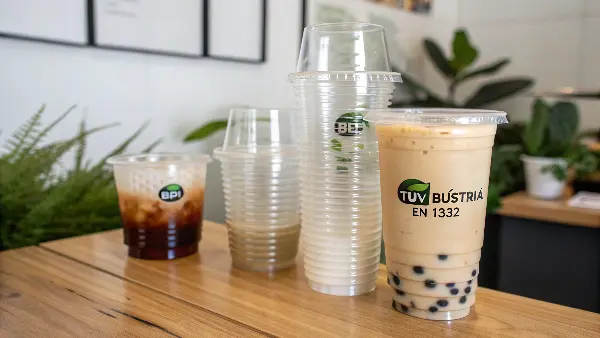
As someone who helps businesses navigate the world of sustainable packaging, I see this challenge every day. You want to make the right choice, but the options and terminology can be overwhelming. Don’t worry, this guide will break down everything you need to know about choosing the right cups. Together, we’ll explore materials, certifications, and performance to find the perfect fit for your brand.
What is the difference between biodegradable and compostable cups?
You’ve seen the words "biodegradable" and "compostable" on countless products, often used as if they mean the same thing. This confusion can lead to well-intentioned businesses choosing products that don’t live up to their green promises. Let’s clear up the difference so you can make an informed decision for your brand.
Essentially, all compostable products are biodegradable, but not all biodegradable products are compostable. "Biodegradable" is a vague term meaning a product can be broken down by microbes over time, which could be years and may leave toxic residue. "Compostable" is a precise, certified standard. It guarantees a product will break down into natural elements in a commercial facility within a specific timeframe (e.g., 180 days) without leaving any harm behind.
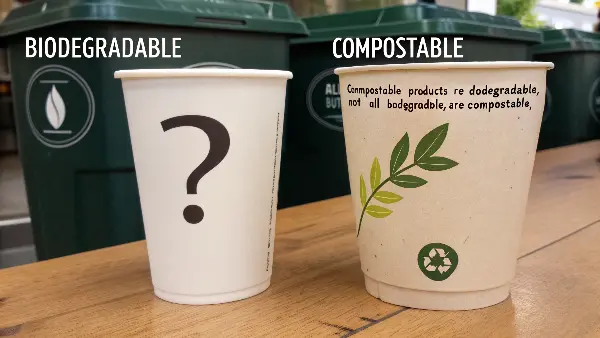
When sourcing for a business like yours, this distinction is critical. A "biodegradable" claim without certification often means little in practice. If a cup isn’t designed for a specific disposal system, it often ends up in a landfill. There, deprived of oxygen, it can release methane, a potent greenhouse gas. That’s why at Ecosourcecn, we always steer our partners, like Jacky in Canada, towards certified compostable options. This guarantees the product has a clear, environmentally beneficial end-of-life path, provided the right infrastructure is available.
Unpacking "Biodegradable"
The term "biodegradable" simply means that a material can be broken down by living organisms, like bacteria or fungi. On the surface, this sounds great. However, the term lacks a defined timeframe or environmental context. A log of wood is biodegradable, but it could take decades to decompose. Similarly, some plastics marketed as "biodegradable" may just break into smaller microplastics, creating a bigger problem. Without a certification, you have no guarantee of how long it will take or what it will leave behind. For a packaging specialist like Jacky, this ambiguity is a major risk. It could lead to greenwashing claims and products that ultimately contaminate recycling streams or pollute landfills.
Understanding the "Compostable" Standard
"Compostable" is the term you should be looking for. It carries a specific, scientific meaning. For a product to be certified compostable, it must meet strict standards like ASTM D6400 (in the US) or EN 13432 (in Europe). These standards require that the product:
- Disintegrates: At least 90% of the material must break into small, non-visible pieces within 12 weeks in a composting environment.
- Biodegrades: At least 90% of the organic carbon must convert to CO2 within 180 days.
- Leaves No Toxins: The resulting compost must be tested for heavy metals and other toxins to ensure it’s safe for plant growth.
These conditions are only met in industrial composting facilities, not in a typical backyard compost pile. Therefore, choosing certified compostable cups means you are providing a product designed for a circular system.
| Feature | Biodegradable | Certified Compostable |
|---|---|---|
| Definition | Breaks down by natural processes. | Breaks down into organic matter in a facility. |
| Timeframe | Undefined; can take hundreds of years. | Defined; typically within 90-180 days. |
| End Result | Can leave microplastics or toxic residue. | Creates nutrient-rich compost (humus). |
| Verification | Often a marketing claim; no standard. | Third-party certified (BPI, EN 13432). |
| Disposal | Unclear; usually ends up in landfill. | Industrial or commercial composting facility. |
Ultimately, for a business aiming for true sustainability, the choice is clear. Certified compostable products offer accountability and a genuine environmental benefit that a simple "biodegradable" label cannot.
What material is 100% biodegradable?
You’re searching for a truly eco-friendly material, one that returns to the earth completely. The term "100% biodegradable" sounds perfect, but what does it actually mean? This promise can be misleading if not properly understood, leading you to materials that don’t perform as expected or don’t break down cleanly.
No manufactured material is "100% biodegradable" in all conditions. However, materials like uncoated paper, bagasse (sugarcane pulp), and certain bioplastics like PLA are considered fully biodegradable under specific circumstances. For them to break down completely and harmlessly, they require the right environment—often an industrial composting facility where temperature, moisture, and microbes are carefully controlled. Without these conditions, even these materials can persist in landfills for years.
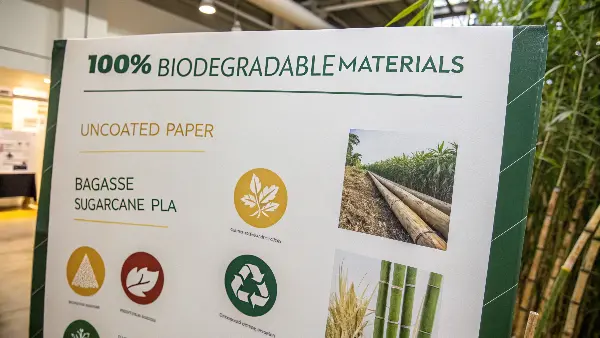
I remember working with a client who switched to "100% biodegradable" cups, only to realize they were not certified compostable. Their local waste management couldn’t process them, and the cups ended up in the landfill, negating the environmental benefit. This is why focusing on the disposal process and certifications is just as important as the material itself. A material is only as good as the system designed to handle it at the end of its life. Let’s look at the top contenders for bubble tea cups and how they truly perform.
Plant-Based Champions: PLA and Bagasse
When we talk about eco-friendly materials for food service, two names come up frequently: PLA and Bagasse. Each has unique properties that make it suitable for different applications.
-
PLA (Polylactic Acid): This is the star material for cold bubble tea cups. Derived from fermented plant starches like corn or sugarcane, PLA is a bioplastic that mimics the clarity and rigidity of traditional PET plastic. It’s perfect for showing off colorful bubble tea drinks. However, it has a low melting point, so it’s not suitable for hot beverages. To biodegrade properly, PLA requires the high temperatures of an industrial composter. In a landfill or the ocean, it will persist for a very long time, much like conventional plastic. So, "fully biodegradable" for PLA means "commercially compostable."
-
Bagasse: This material is the fibrous pulp left over after sugarcane stalks are crushed to extract their juice. It’s a brilliant example of upcycling an agricultural byproduct. Bagasse is molded into sturdy, heat-resistant products like lids, bowls, and hot cups. It has a natural, fibrous look and feel. Like PLA, bagasse products are certified commercially compostable and will break down efficiently in the right facility. They can also biodegrade in a home compost setting, though it will take longer.
The Paper Paradigm: Is It Truly Green?
Paper seems like an obvious eco-friendly choice. It comes from trees, a renewable resource. However, the story is more complex. Standard paper cups used for drinks need a lining to make them waterproof.
-
PE-Lined Paper: Most paper cups are lined with polyethylene (PE), a type of plastic. This lining makes the cup difficult to recycle because separating the paper from the plastic is a complex and expensive process. These cups are neither recyclable in most places nor compostable.
-
PLA-Lined Paper: This is a much better alternative. The cup uses paper, often from FSC-certified forests, and lines it with plant-based PLA instead of plastic. This makes the entire cup commercially compostable. These are an excellent choice for hot bubble tea drinks.
The table below breaks down these key materials for a quick comparison.
| Material | Best For | Pros | Cons | End-of-Life |
|---|---|---|---|---|
| PLA | Cold Drinks | Clear, Sturdy, Plant-Based | Not heat-resistant, requires industrial composting | Commercial Compost |
| Bagasse | Lids, Hot Cups | Renewable, Heat-Resistant, Home Compostable | Opaque, can have a fibrous texture | Commercial/Home Compost |
| PLA-Lined Paper | Hot Drinks | Good insulation, Plant-Based Lining | Opaque, requires industrial composting | Commercial Compost |
| PE-Lined Paper | Hot/Cold | Widely available, cheap | Not recyclable or compostable, petroleum-based lining | Landfill |
For a business focused on sustainability, choosing PLA for cold cups and PLA-lined paper or bagasse for hot options provides a comprehensive, certified compostable solution.
What is the most environmentally friendly disposable cup?
You want to offer your customers the best experience without harming the planet. Choosing the "most" environmentally friendly cup feels like a huge decision, with every option having its own pros and cons. The fear of making the wrong choice can be paralyzing, but finding the right answer is about clarity, not complexity.
The most environmentally friendly disposable cup is one that is part of a circular system. This means it’s made from renewable resources and can be returned to the earth as compost. For bubble tea, this is often a certified commercially compostable PLA cup for cold drinks or a PLA-lined paper cup for hot drinks. Its eco-friendliness, however, depends entirely on access to industrial composting facilities for proper disposal. Without that, even the best cup ends up in a landfill.
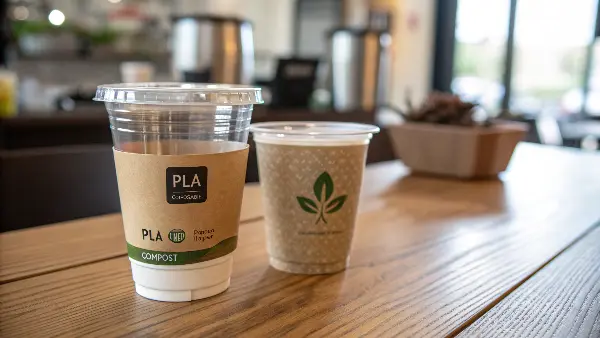
When I consult with packaging specialists like Jacky, we don’t just look at the cup’s material. We analyze its entire lifecycle, from raw material sourcing to its final destination. A cup made from sustainably sourced paper (FSC certified) and lined with plant-based PLA is a fantastic start. But the key question is: what happens after the customer finishes their drink? Educating customers on how to dispose of the cup correctly and partnering with local composting services are the steps that transform a good product into a great environmental solution.
A Lifecycle Approach to "Eco-Friendly"
To truly determine the greenest option, we must consider the full journey of the cup. A lifecycle assessment (LCA) is a framework used to evaluate the environmental impacts associated with all stages of a product’s life.
-
Raw Material Sourcing: Is the material from a renewable resource? PLA comes from corn or sugarcane, and paper can come from sustainably managed forests (look for FSC certification). This is a huge advantage over petroleum-based plastics. However, we must also consider the agricultural impacts of growing these crops, such as water use and land conversion.
-
Manufacturing: How much energy and water are used to produce the cup? PLA manufacturing has become much more efficient, now using significantly less energy and producing fewer greenhouse gases than traditional plastic production.
-
Use: The cup must be functional. A cup that leaks or cracks is not sustainable because it creates waste and frustrated customers. Both PLA and PLA-lined paper cups perform exceptionally well for bubble tea, matching the performance of their plastic counterparts.
-
End-of-Life: This is the most crucial stage. An eco-friendly cup must have a viable, beneficial disposal path. Certified compostable cups are designed to be turned into soil amendment in an industrial facility. This closes the loop. If these facilities aren’t available in your region, the cup will likely end up in a landfill, where its benefits are largely lost.
Comparing the Top Contenders
Let’s put the best options head-to-head. For a bubble tea shop, you primarily need clear cold cups and potentially some hot cups.
-
Clear PLA Cups (Cold Drinks): For the classic bubble tea experience, nothing beats a clear cup. PLA provides that while being made from renewable resources. Its primary role is to replace traditional PET plastic cups. From a lifecycle perspective, its main strength is its compostability, which diverts waste from landfills and avoids the use of fossil fuels. Its major dependency is on the availability of commercial composting services.
-
PLA-Lined Paper Cups (Hot Drinks): For hot milk teas or other warm beverages, these cups are the sustainable champions. They replace PE-lined paper cups, which are a landfill nightmare. By using a plant-based liner, the entire cup becomes compostable. Sourcing paper from FSC-certified forests ensures responsible forestry practices.
-
Reusable Cups: We can’t ignore the ultimate eco-friendly option: reusable cups. Encouraging customers to bring their own cups with a small discount is a powerful way to reduce waste to zero. While not a "disposable" cup, promoting a reusable cup program should be part of any serious environmental strategy.
The verdict? For disposable options, a certified compostable cup (PLA or PLA-lined paper) sourced from a reputable supplier is the most environmentally friendly choice, but only if you can guide it to a commercial composting facility.
What is worse for the environment, plastic or styrofoam cups?
When considering a switch to sustainable options, it’s helpful to understand just how bad the alternatives are. Businesses often face a choice between two cheap, common materials: plastic and Styrofoam. Both have a terrible reputation, but which one actually causes more harm to our planet? The answer is not as simple as you might think.
Both plastic and Styrofoam (polystyrene) cups are extremely harmful to the environment, but in different ways. Styrofoam is worse due to its non-recyclable nature, bulky landfill presence, and the potential release of harmful chemicals during production. Plastic cups, while also a major pollution source, are at least technically recyclable in some areas, though recycling rates remain very low. Ultimately, both are poor choices that persist for centuries.
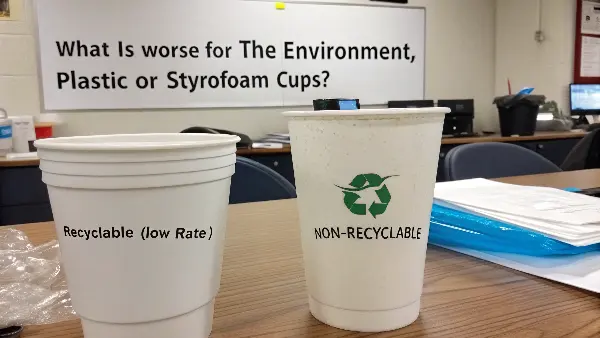
I’ve had many conversations with clients who were using one of these materials and wanted to change. They often feel stuck, thinking it’s a choice between two evils. My response is always the same: it’s not about choosing the lesser evil. It’s about rejecting both in favor of a truly sustainable alternative. Both plastic and Styrofoam are derived from non-renewable fossil fuels and create pollution that lasts for generations. This comparison simply highlights the urgent need to move away from them entirely.
The Case Against Styrofoam (Polystyrene)
Styrofoam is a brand name for expanded polystyrene (EPS). It is lightweight, a great insulator, and very cheap to produce, which is why it became so popular for coffee cups and takeout containers. However, its environmental cons are massive.
- Production Hazards: The primary building block of polystyrene is styrene, a chemical classified as a possible human carcinogen by the World Health Organization. Production workers are at risk, and manufacturing facilities can release hazardous air pollutants.
- Non-Recyclable & Non-Biodegradable: Styrofoam is technically recyclable, but it’s 95% air, making it economically unfeasible to collect, transport, and process. As a result, almost no curbside recycling programs accept it. It does not biodegrade; it simply breaks into smaller and smaller pieces that contaminate soil and waterways indefinitely.
- Pollution and Health Risks: Those tiny pieces are easily ingested by wildlife, causing injury or death. When heated, Styrofoam can potentially leach styrene into food and beverages, posing a health concern for consumers.
The Problem with Plastic (PET or PP)
The plastic cups commonly used for cold drinks like bubble tea are typically made from PET (polyethylene terephthalate) or PP (polypropylene). While they feel more modern than Styrofoam, their environmental footprint is just as deep.
- Fossil Fuel Dependency: Like Styrofoam, these plastics are derived from petroleum or natural gas. Their extraction and refinement are energy-intensive processes that contribute heavily to greenhouse gas emissions and climate change.
- Recycling Realities: PET is one of the most recycled plastics, but global recycling rates are still alarmingly low. Many plastic cups end up in landfills or, worse, in our oceans. Plastic does not biodegrade but photodegrades, breaking down from sunlight into microplastics that poison marine ecosystems and enter our food chain.
- Persistence in the Environment: A single plastic cup can take over 450 years to decompose. Every plastic cup ever made, unless incinerated or successfully recycled, still exists on our planet in some form. This staggering longevity makes it a permanent pollutant.
| Impact Category | Styrofoam (Polystyrene) | Plastic (PET/PP) |
|---|---|---|
| Resource Origin | Fossil fuels (non-renewable) | Fossil fuels (non-renewable) |
| Production Impact | Uses styrene (potential carcinogen), energy-intensive | Energy-intensive, significant greenhouse gas emissions |
| Recyclability | Virtually non-existent in practice | Low, but possible for PET in some areas |
| Biodegradability | Does not biodegrade; breaks into small pieces | Does not biodegrade; breaks into microplastics |
| Environmental Harm | Bulky in landfills, easily ingested by wildlife | Major source of ocean pollution, chokes marine life |
In conclusion, debating whether plastic or Styrofoam is worse is like asking whether it’s better to be hit by a bus or a train. The real solution is to get off the tracks entirely and embrace certified compostable alternatives that work with nature, not against it.
Conclusion
Choosing the right disposable cup is about more than just the material; it’s about embracing a circular system. By understanding the critical difference between biodegradable and compostable, you can avoid greenwashing. Opt for certified compostable materials like PLA and partner with local composting facilities to ensure your cups truly return to the earth, protecting your brand and our planet.

